MinbarLive was created out of a real need in a community in Zagreb: how to help congregants coming from different parts of the world understand the khutbah, even if they don’t speak Croatian. Today, MinbarLive is a platform for live transcription, khutbah translation, and multilingual digital Islamic content.
“MinbarLive was born from a simple question: how can we help every person in the mosque truly understand the message of the khutbah?”
In brief
MinbarLive is a platform for live khutbah translation and AI transcription, created from the needs of a multilingual congregation in Zagreb. Learn how it helps mosques make the khutbah message understandable to everyone.
Make sure every congregant understands the khutbah
If your congregation includes people who don’t understand the language of the khutbah, MinbarLive can help the message reach them in real time. With live transcription, translation into multiple languages, and simple QR access, the khutbah becomes more accessible to everyone.
In the past few years, Zagreb has changed significantly. Among the people who live and work in the city every day, there are more and more foreign workers from different parts of the world. This change is especially noticeable on Fridays, at Jumu’ah, when people of different languages, cultures, and life stories gather in the mosque.
They come because they want to be part of the community. They come to perform the Jumu’ah prayer, stand in the rows (saff), listen to the khutbah, and take part in what Jumu’ah is — the weekly gathering of Muslims around a shared message. However, for many of them one serious obstacle has appeared: the Croatian language.
They can be present in the mosque, but if they do not understand the khutbah, they are deprived of an important part of Jumu’ah. The khutbah is not an ordinary talk before the prayer. It is a reminder, advice, and a message to the community. When a person does not understand it, they are physically there, but the message does not fully reach them.
It was precisely from this real problem that the idea for MinbarLive was born.
How did the idea for MinbarLive come about?
The idea did not start in an office, on a whiteboard, or as a classic tech project. It started in the mosque, from the need to help people who are already part of the congregation, but cannot fully follow what is being said.
Adnan, a member of the majlis board, was among the first to feel this need strongly. He watched the congregation’s structure change and saw that there were more and more people among the congregants who understood Croatian very little or not at all. For him, this was not just a practical issue. It was a question of the community’s responsibility.
If a person comes to Jumu’ah, wants to fulfill their obligation, and wants to listen to the khutbah, can we help them truly understand the message? Can we enable them to be not only present, but also included?
From that question, the search for a solution began.
Why weren’t existing solutions enough?
The first step was to explore tools that already exist. One of the solutions that was tested was Stenomatic. At first, it seemed like such a tool could help: speech is turned into text, the text is translated, and congregants could at least partially follow the khutbah.
However, in practice, two major problems quickly became apparent.
The first was the price. For something used every week, the cost quickly becomes an important factor. Mosques and Islamic communities have to manage their budgets carefully, so a solution that is expensive in the long run can hardly become a regular practice.
The second problem was even more important: translation quality. The khutbah has a specific structure and language. It often mentions Qur’anic verses, hadith, Arabic expressions, and Islamic terms that cannot always be translated literally. Words such as sabr, taqwa, niyyah, akhlaq, or ummah carry meaning that depends on context.
Generic tools can be useful for everyday speech, meetings, or daily communication. But with a khutbah, a mistranslated word is not just a technical error. It can change the meaning of the message.
That’s when it became clear: it is not enough to have a tool that translates. What’s needed is a solution that understands the context of the khutbah.
What is MinbarLive?
MinbarLive is a platform for live transcription and translation of the khutbah, developed for mosques, Islamic centers, and multilingual communities. While the imam speaks, the system turns speech into text and translates it into languages the congregants understand.
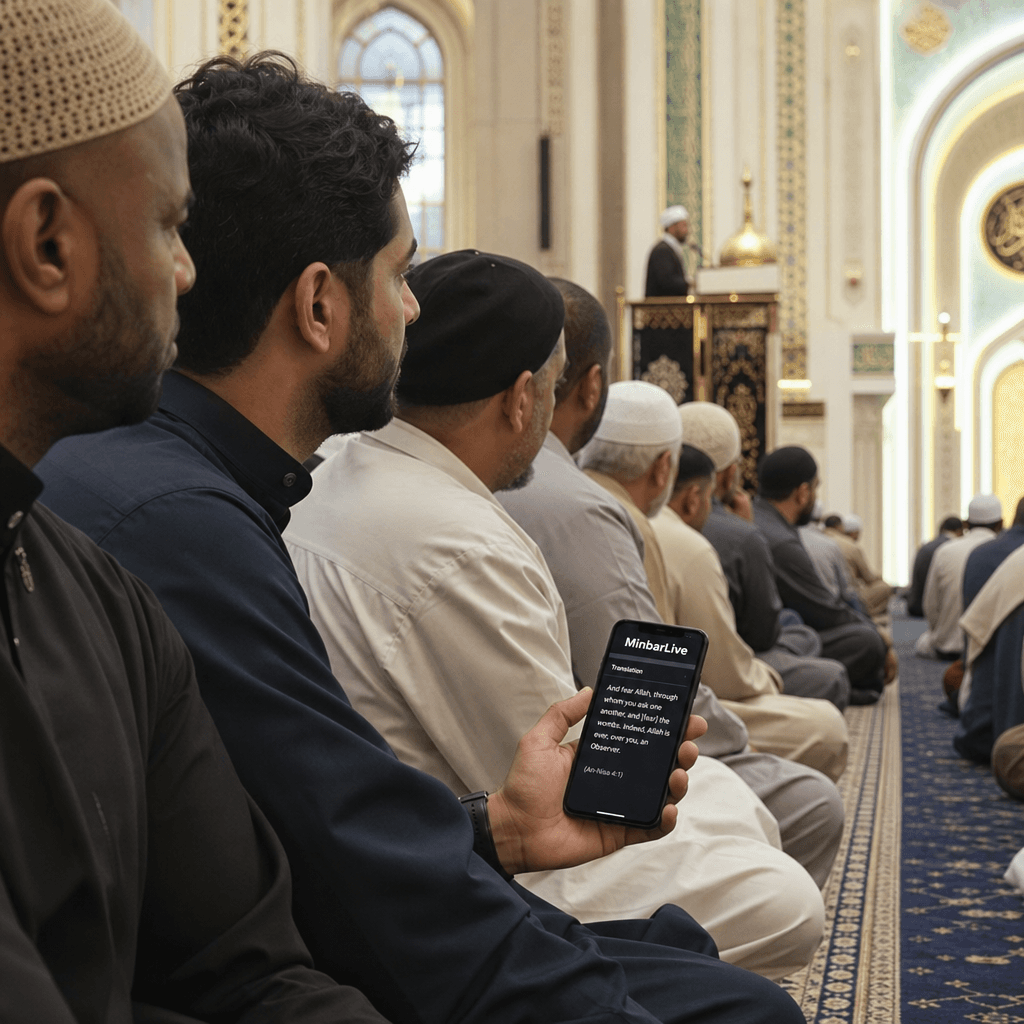
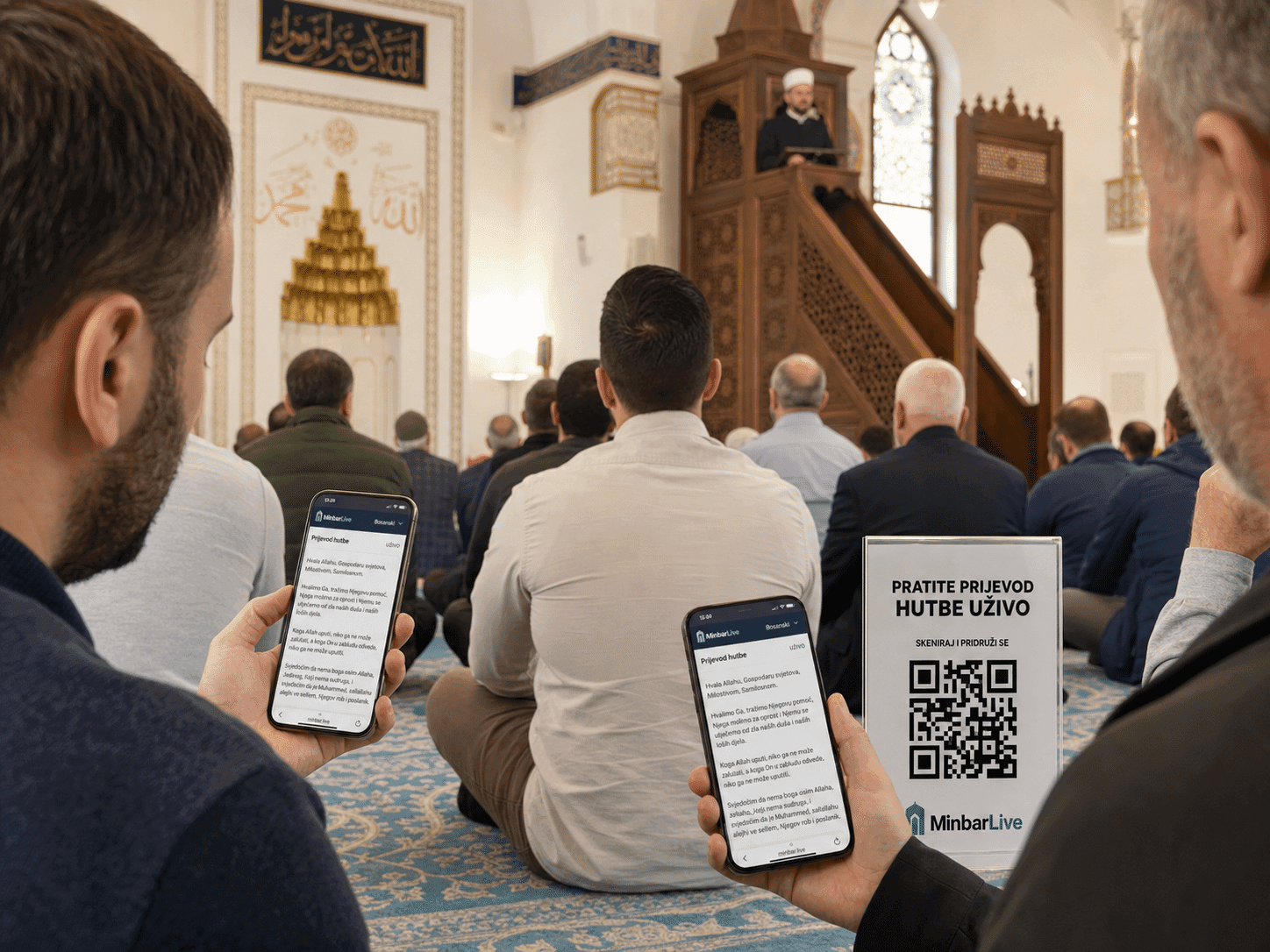
Congregants follow the translation on their phone, most often via a QR code placed in the mosque. There’s no app installation, special devices, or complicated instructions. A person scans the code, opens the link, chooses a language, and follows the khutbah in real time.
What makes MinbarLive special is not only the technology, but the reason it was created. The goal is not to translate words mechanically, but to help convey the khutbah’s message as clearly, naturally, and accurately as possible.
What does MinbarLive look like in practice?
Imagine a Friday in Zagreb. The mosque is full. In the prayer rows are people who have lived in Croatia for years, young people who grew up in a multilingual environment, and foreign workers who arrived only recently.
The imam begins the khutbah. One part of the congregation understands every word. Another understands only parts. A third understands almost nothing.
With the MinbarLive solution, there is a QR code at the entrance or on the notice board. A congregant scans it, chooses a language, and follows the translation on their phone. Someone reads the translation in Arabic, someone in Turkish, someone in English, German, or another language.
The imam continues speaking as always. Jumu’ah proceeds normally. But the message now reaches a much larger number of people.
It’s a small technical change, but a big change for the community.
Why is live khutbah translation important for today’s congregations?
Many congregations today are no longer linguistically uniform. Especially in European cities, people from different countries and generations gather in the same space. Some speak the local language, others are only learning it, and others rely more on English, Arabic, Turkish, Albanian, or another language.
In such an environment, the language issue becomes an issue of inclusion. If the khutbah’s message reaches only those who understand the imam’s language, part of the congregation remains on the sidelines, even though they are physically present.
Live khutbah translation helps reduce that distance. It does not change the khutbah, it does not change the imam, and it does not change the act of worship. It only removes the barrier that stands between people and the message.
MinbarLive and Islamic terminology
One of the most important differences between the MinbarLive platform and generic translation tools is its special focus on Islamic terminology.
A khutbah is not a business meeting, a school lecture, or an ordinary conversation. It has its own rhythm, structure, and meaning. It often combines the local language with Arabic quotations and concepts that have depth in the Islamic tradition.
That’s why translating a khutbah must be more than a fast word-for-word translation. It must respect context. Sometimes the best translation is the one that does not translate a term literally, but conveys it in a way a believer can understand in their own language.
MinbarLive was developed with precisely this awareness: Islamic content requires a more careful approach than ordinary machine translation.
From live khutbah translation to a platform for digital Islamic content
Although MinbarLive started as a solution for live khutbah translation, it quickly became clear that mosques and Islamic communities have broader needs. Khutbahs, lectures, educational programs, video content, and podcasts increasingly cross the boundaries of a single language.
That’s why MinbarLive gradually evolved into a platform for multilingual digital content. Alongside live transcription and khutbah translation, possibilities open up for archiving content, preparing subtitles, processing lectures, and sharing Islamic content more easily with people who speak different languages.
The essence remains the same: helping communities make their message understandable and accessible to more people.
Who is MinbarLive for?
MinbarLive is intended for mosques, Islamic centers, majlises, imams, and organizations that want to communicate better with a multilingual congregation. It is especially useful in communities where foreign workers, students, travelers, new families, or young people gather—young people who may understand another language better than the language in which the khutbah is delivered.
It is also useful for diaspora congregations, where different generations often come together. Older members may better understand the language of origin, while younger members better understand the language of the country they live in. In such an environment, MinbarLive can be a bridge between generations, languages, and experiences.
A digital mosque does not mean less tradition
When technology in the mosque is mentioned, caution sometimes arises. And that is understandable. The mosque is not a place for unnecessary distraction, and the khutbah is not content that should be turned into a technological experiment.
But MinbarLive is not designed to replace the Jumu’ah experience. Its purpose is simple: to help people understand what is already being said.
A QR code on the wall is not a replacement for the khutbah. It is a bridge to those who want to listen, but whose language stands in the way. If technology helps more people understand the message, then it does not distance the community from tradition—it helps carry tradition forward.
Conclusion: MinbarLive was created so the message can reach people
MinbarLive was created from a concrete need within one community in Zagreb. An increasing number of foreign workers were coming to Jumu’ah, but could not understand Croatian well enough to follow the khutbah. Out of a sense of responsibility toward these people, the idea was born for a solution that would help them be not only present, but included.
Today, MinbarLive is more than the initial idea. From a tool for live khutbah translation, it has grown into a platform for multilingual digital Islamic content. Still, its essence remains the same: bringing the khutbah’s message closer to people, regardless of where they come from and what language they speak.
Because the mosque is not only a place where people stand in the same row. It is a place where they gather around the same message.
And MinbarLive helps them truly understand that message.
Do you want to enable live khutbah translation in your mosque?
If there are people in your congregation who do not understand the khutbah’s language, MinbarLive can help change that. With live transcription, translation into multiple languages, and simple access via a QR code, the khutbah can become more accessible to everyone.
Request a demo and see how MinbarLive can help your congregation.
Next step
Make sure every congregant understands the khutbah
If your congregation includes people who don’t understand the language of the khutbah, MinbarLive can help the message reach them in real time. With live transcription, translation into multiple languages, and simple QR access, the khutbah becomes more accessible to everyone.